
Blog Details
- Member
- March 4, 2026
Plurilingual Contact Intelligence Infrastructure
The rapid expansion of global mobility, digital communication, and multilingual societies has exposed a fundamental limitation in current digital systems: they are still built on monolingual assumptions. Most contact management platforms assume that a user primarily operates in one dominant language and script. However, real-world behavior tells a different story. Families, businesses, and communities increasingly operate across multiple languages, scripts, and cultural naming conventions simultaneously. This structural mismatch between human multilingual cognition and monolingual digital architecture creates persistent friction in everyday communication.
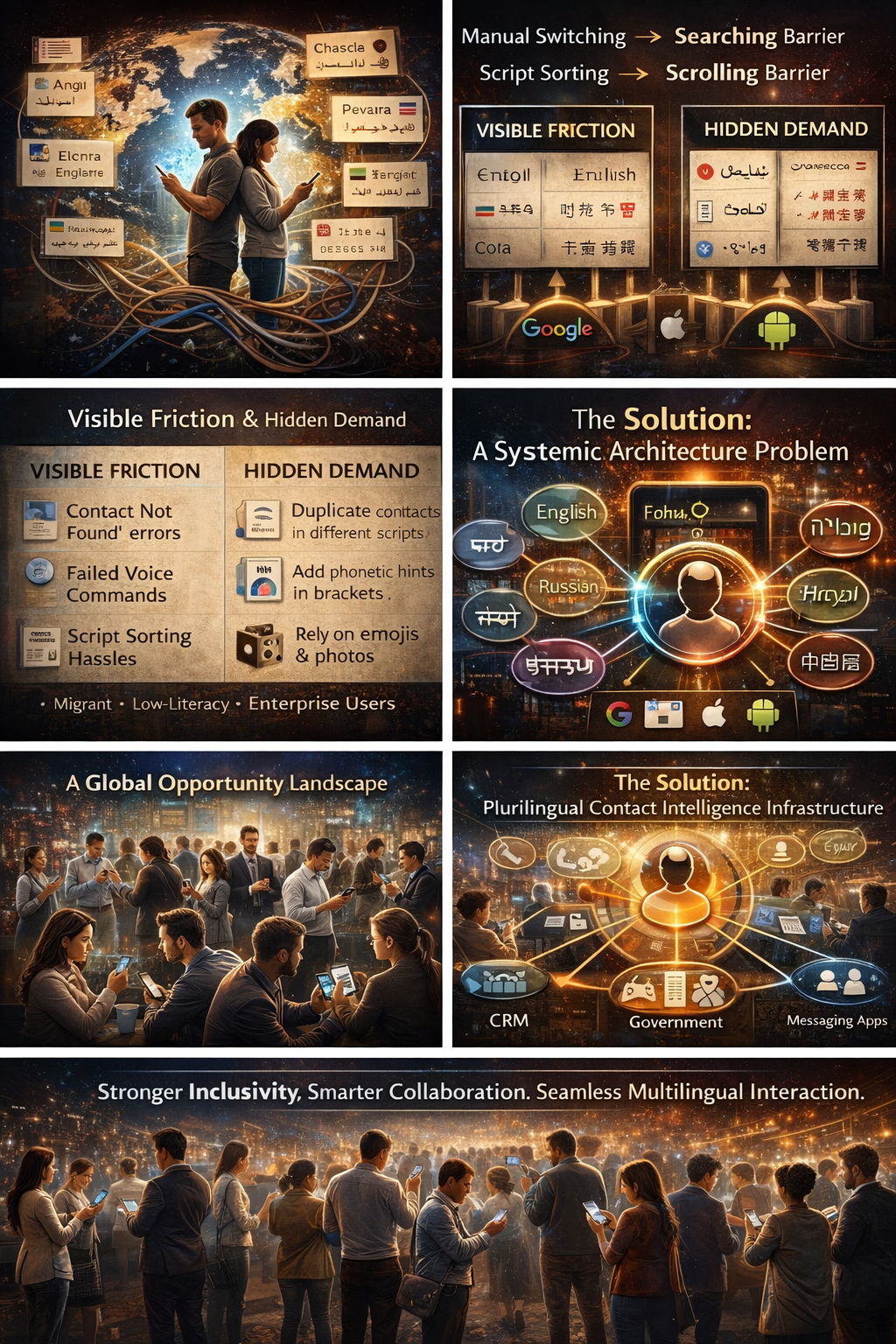
The need for a plurilingual contact intelligence infrastructure emerges from this gap. Users frequently manage contacts written in Latin, Cyrillic, Arabic, Devanagari, Chinese, and other scripts within the same device. Searching across these scripts often requires manual keyboard switching, exact spelling recall, or prior transliteration. Voice commands may fail due to accent variation or code-switching. Sorting systems privilege dominant scripts, unintentionally marginalizing others. These inefficiencies accumulate into cognitive load, time loss, and reduced usability—particularly in high-mobility societies and emerging markets.
Demand for a more inclusive system is both visible and hidden. Visible demand appears in user frustration with failed search results and inconsistent voice recognition. Hidden demand appears in adaptation strategies: users duplicate contacts in different scripts, insert phonetic hints in brackets, or rely on emojis and images to compensate for system weaknesses. Enterprises and public institutions managing multilingual databases face similar challenges when dealing with diverse populations. As global migration and cross-border digital work increase, these pressures will intensify rather than diminish.
The core problem lies not in superficial interface design but in architectural bias. Even advanced ecosystems developed by companies such as and operate largely within language-specific processing frameworks. Voice systems like Siri and Google Assistant support multiple languages, yet they typically process them in parallel monolingual streams rather than fluidly integrated hybrids. Code-switching, accent diversity, and cross-script identity mapping remain constrained by foundational design choices.
The proposed solution is a plurilingual contact intelligence infrastructure built around a script-agnostic identity graph. Instead of treating each spelling or script as an isolated entry, the system links native scripts, transliterations, phonetic approximations, and cultural variants into a unified identity node. Search becomes intent-based rather than spelling-dependent. Voice recognition becomes accent-resilient through adaptive phonetic modeling. Code-switched commands are interpreted naturally rather than rejected as anomalies. Optional visual identity clustering can further enhance usability for low-literacy users and emerging smartphone populations.
The opportunity spans consumer, enterprise, government, and AI ecosystems. Multilingual households, international students, migrant professionals, and diaspora communities represent immediate consumer demand. Enterprises managing global CRM databases require cross-script identity consistency. Public sector systems serving diverse citizens need inclusive identity resolution to improve accessibility and service delivery. As AI voice interfaces increasingly replace manual input, robust multilingual identity infrastructure becomes foundational to reliable digital interaction.
Strategically, this represents a category-creation opportunity rather than an incremental feature enhancement. No dominant technology provider currently positions plurilingual identity resolution as a core infrastructure layer. By addressing multilingual cognition at the architectural level, such a system can establish defensible intellectual property, create integration partnerships at the operating system level, and build a data moat through continuous linguistic refinement. The solution aligns with global demographic realities rather than legacy design assumptions.
In the long term, plurilingual contact intelligence would reduce cognitive friction for billions of users, strengthen cross-cultural communication, and enhance digital inclusivity. As societies become more interconnected and AI-mediated interaction becomes ubiquitous, seamless identity resolution across languages will shift from a convenience feature to a foundational requirement. The transition from monolingual bias to plurilingual infrastructure represents not merely a technological upgrade but an evolution toward systems that reflect how humans actually communicate.